Prix d’un implant dentaire à Casablanca : à quoi s’attendre
À Casablanca, un implant dentaire posé avec sa couronne se situe le plus souvent entre 8 000 et 15 000 dirhams. L’écart dépend de la marque de l’implant, du type de couronne et de la nécessité ou non d’une greffe osseuse.
Que comprend ce prix ?
Un implant se facture en trois postes, qu’un devis sérieux détaille toujours :
- L’implant, vis en titane qui remplace la racine, de 6 000 à 8 000 MAD selon la marque.
- Le pilier, pièce de liaison entre l’implant et la dent visible.
- La couronne en céramique ou zircone, de 3 000 à 5 000 MAD.
S’y ajoutent la consultation et le scanner 3D, indispensable pour mesurer le volume osseux.
Au cabinet, le prix varie entre 700 et 1000 dhs.
Pourquoi les devis varient-ils autant ?
Quatre facteurs expliquent presque tous les écarts : la marque de l’implant, les grandes marques étant traçables et leurs pièces encore disponibles dix ans plus tard, le type de couronne, l’état de l’os qui impose parfois une greffe, et l’équipement du cabinet.
Choisir au prix le plus bas est le mauvais réflexe : un implant doit durer des décennies, et une reprise coûte plus cher que la pose initiale.
Combien de temps faut-il compter ?
La pose dure 30 à 60 minutes sous anesthésie locale, après consultation et scanner. Suivent 2 à 4 mois de cicatrisation osseuse, avec ou non une dent provisoire, puis deux à trois séances pour la couronne. Soit 3 à 5 mois au total.
Une question sur votre situation ?
Un examen au cabinet reste le seul moyen de répondre précisément à votre cas.
Le Centre Dentaire Marina reçoit à l’angle du Bd Zerktouni et du Bd de la Corniche, à Casablanca.
Prendre rendez-vous : 0522 29 52 82, 0522 48 14 02, 06 61 31 77 06 ou sur Dabadoc.
Replacing an old bridge with a single-tooth implant rehabilitation
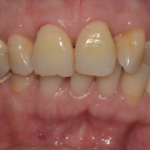
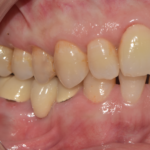
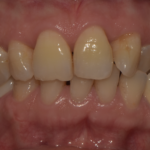
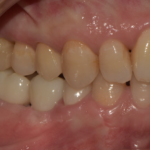
A patient came to Centre Dentaire Marina with functional discomfort caused by an old bridge that had become unsuitable.
After a thorough diagnosis, the bridge was removed and replaced with a single implant-supported restoration. This solution restored optimal passage for dental floss and improved the effectiveness of brushing, while ensuring comfortable chewing and excellent functional comfort.
The advanced resorption of the edentulous ridge was managed with a bone graft, which corrected the unattractive appearance of the elongated tooth and produced a crown with harmonious proportions.
The patient thus regained comfort, stability and complete day-to-day satisfaction.
We now limit the use of bridges to situations where the abutment teeth themselves need a prosthetic restoration. Where the adjacent teeth are healthy, a dental implant is the reference solution — reliable and long-lasting.
For more information, please contact us at CENTRE DENTAIRE MARINA on +212522295282 / +212522481402 / +212661317706 or visit our website: www.drfaisselbennouna.com or our Instagram page: https://instagram.com/centredentairemarina
Implant rehabilitation after mandibular tooth breakdown
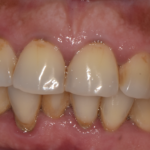
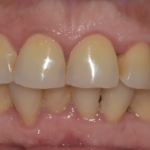
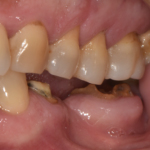
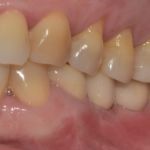
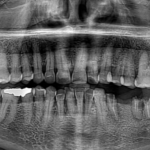
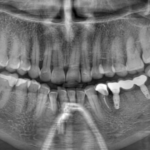
This patient came to Centre Dentaire Marina with significant breakdown of the teeth on the left side of the mandible. Clinical examination revealed two retained roots that could not be saved, together with a missing tooth in the same area.
Before undertaking the implant rehabilitation, a preparatory phase was carried out to make the whole mouth healthy: full scaling, treatment of the cavities present on the other teeth, and restoration of the oral environment.
Once the unrestorable roots had been extracted, dental implants and a bone graft were placed in order to replace the lost teeth and restore chewing function for the long term.
✅ The final result allowed the patient to regain comfortable chewing, a stable bite and a harmonious, attractive smile, while protecting her oral health for the long term.
Because a successful implant rehabilitation always begins with a healthy mouth.
For more information, please contact us at CENTRE DENTAIRE MARINA on +212522295282 / +212522481402 / +212661317706 or visit our website: www.drfaisselbennouna.com
Dental implants
Losing a tooth is never a small matter: beyond appearance, it unbalances the way you chew and, over time, leads to progressive loss of jawbone. A dental implant is today the closest solution there is to a natural tooth.
What is a dental implant?
An implant is a titanium screw fixed into the bone, taking the place of a natural tooth root. It replaces a missing tooth without touching the neighbouring teeth.
Its length and diameter are matched to the volume of bone available, established beforehand by digital X-ray imaging.
Osseointegration: the key phase
Once placed, the implant needs a period of osseointegration which can take two to six months. Unlike a tooth, the implant has to fuse literally with the bone before it can function.
Loading it with a crown is therefore delayed. In some favourable cases, however, a temporary crown can be fitted on the day of placement.
Every bone situation is different: the exact timescale is only decided once the X-rays have been reviewed.
The advantages of implant dentistry
Implant dentistry represents a genuine advance in the quality of life of thousands of people. It makes it possible:
- to avoid needlessly sacrificing healthy teeth, as a bridge requires;
- to avoid wearing a removable denture with clasps;
- to enjoy the comfort of natural teeth with complete peace of mind;
- to restore a flawless appearance;
- to avoid the bone loss that follows the extraction of a tooth.
Who is it for?
A dental implant is the optimal solution whether one, several or all of the teeth are missing. Almost anyone can therefore benefit from a replacement that looks and functions exactly like natural teeth.
A preliminary assessment — general health, bone quality and volume, oral hygiene — confirms that implants are appropriate and allows the procedure to be planned.