Periodontics
Bleeding gums: understanding periodontics

Gums that bleed when you brush are never “normal”. It is the first sign of periodontal disease — and, caught in time, it is reversible.
1. Healthy gums
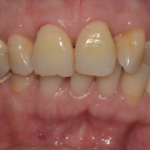
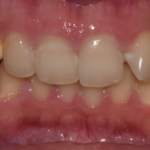
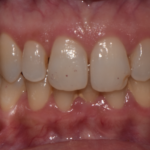
Healthy gums are pink in colour with a lightly stippled, orange-peel texture. They are naturally able to defend themselves against bacteria and viruses.
2. Gingivitis
Gingivitis is the term used when bleeding, pain or swelling appear. Detected and treated in time, it is reversible.
3. Periodontitis
Untreated gingivitis progresses to periodontitis. The bacteria advance and, once past the barrier of the gum, attack the bone that supports the teeth.
That bone is destroyed little by little: after a certain time the teeth become loose and painful, they recede and eventually fall out.
Bone destruction is irreversible. That is why early detection changes everything about the prognosis.
Treatment, step by step
- Learning a proper brushing technique — the foundation of the whole treatment, without which nothing holds in the long term.
- Initial treatment: eliminating the direct causes (tartar, plaque) through scaling and subgingival curettage with root planing; then the indirect causes (defective fillings and crowns, overlapping teeth) to make the ground healthy again.
- Application of the dental laser, which achieves deep decontamination of the tissues.
- Periodic review — maintenance: periodontal disease can start progressing again if cleaning standards are no longer kept up.
What to remember
Periodontics is as much about follow-up as it is about treatment. A patient who is treated and then reviewed regularly keeps their teeth; a patient who is treated but then lost to follow-up often sees the disease return.
Further reading
Please note — This article is provided for information only and is not a substitute for a consultation. Only a clinical examination can establish a diagnosis and determine the appropriate treatment.