Oral surgery
Impacted teeth: when a tooth stays trapped in the bone
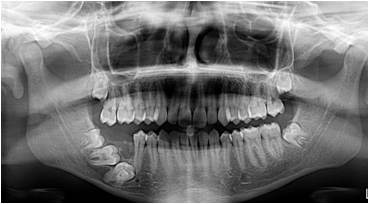
An impacted tooth is a tooth that remains held inside the jaw, never coming through into the mouth. It has therefore failed to erupt normally into the dental arch, because neither the space nor the path of eruption were favourable.
How is the diagnosis made?
The dental surgeon confirms the diagnosis by clinical examination, always supported by X-ray imaging. It is that imaging which makes it possible to locate the tooth precisely, to assess its angle and how close it lies to the surrounding structures (the roots of neighbouring teeth, the nerve, the sinus) before any treatment decision is taken.
What treatment is needed?
What to do depends above all on which tooth is involved.
Where it is a wisdom tooth, the most common course of action remains extraction, particularly when there is not enough space available in the arch.
For other teeth, however, the clinician takes a more conservative approach, aiming to preserve the tooth and to restore both appearance and function:
- Surgical exposure, to uncover the impacted tooth;
- Traction, to bring it gradually into its place in the arch;
- Orthodontic treatment, to complete its alignment.
Every impacted tooth is different: only a reading of the X-rays can determine the most appropriate strategy.
Why seek advice early?
An impacted tooth detected early, particularly in a child or adolescent already undergoing orthodontic treatment, leaves more conservative options open. Regular X-ray checks make it possible to anticipate an impaction before it complicates the rest of the treatment.
Further reading
Please note — This article is provided for information only and is not a substitute for a consultation. Only a clinical examination can establish a diagnosis and determine the appropriate treatment.